
This year, Kent Friends of the Trees introduced a new annual competition – “Tree of the Year.” Parish councils were invited to nominate a tree in their village for consideration by the Judging Panel. The theme for the 2025 competition was “A tree with a story.”
A total of 11 parish councils were good enough to send entries and judging was by no means an easy task.
The winner was a Tulip tree (Liriodendron tulipiferai) on “The Green” in Wye. Not an old tree, only in its mid-fifties, but it impressed the judging team by the role it played in the local community and how its history, short though it was in tree terms, was of significance.
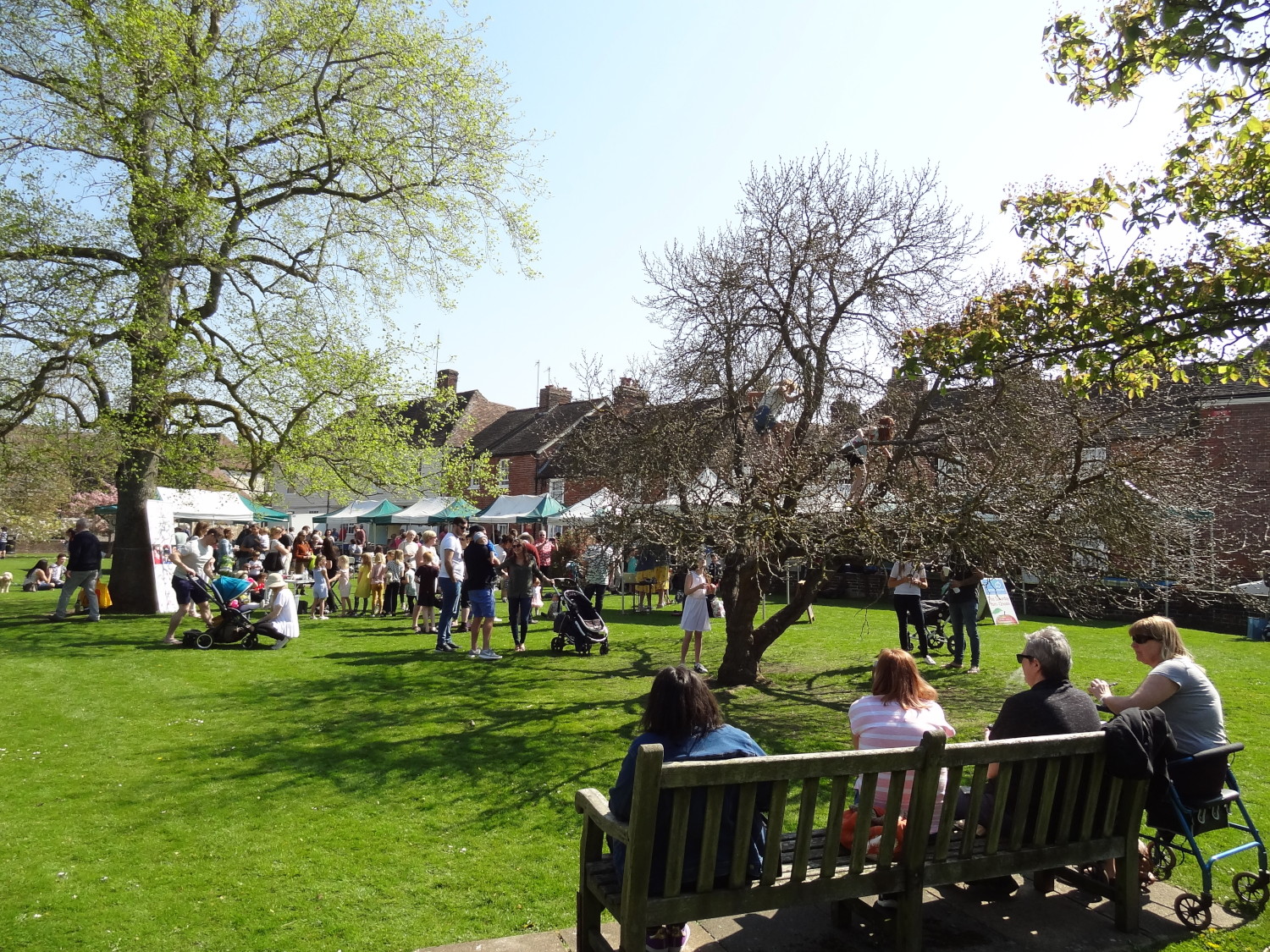
Planted by Kent Men of the Trees in 1969, it has now grown into an imposing and strikingly beautiful specimen which provides the focal point for community life. The Green is part of the site of a Royal Charter Market, the charter being granted in 1225. It continues to fulfil this role and in 1999 it hosted the first Farmers’ Market to be established in Kent. This twice-monthly market is now in its 27th year – the photo shows the tree in a recent market. It is likely that trees like this have added shade to such occasions in the past; although not a tulip tree which was only introduced to Britain in around 1688.
It was planted as a memorial to Basil Sidney Furneaux (1906-1969), a leading soil scientist. Furneaux worked on the Land Utilisation Survey of Kent and the results were published in 1943. His work made a key contribution to food production for the war effort. During his working life, Furneaux walked over thousands of acres across Kent preparing detailed soil and nutritional profiles.
Furneaux applied his scientific knowledge and used a systematic approach to identify the best sites for the planting of orchards and other crops. As such, and with little more than a soil auger, Furneaux’s life’s work was a precursor to the precision farming techniques of today.
In later life, Furneaux served as a governor of Wye College. Wye College closed in 2009 and an “end of an era” picnic was held on the Green with, of course, the Tulip tree in attendance.
Other notable entries came for Loose, with its imposing churchyard yew tree; an impressive oak tree in Teston, situated high on a slope and visible to the surrounding countryside. Not all trees were large, a young, hopefully, disease-resistant elm was entered by Wingham. The variety named Ulmus x “Wingham” after being trialled on a site in the village was, the Parish Council said, “a source of hope for the future.”
All the entrants illustrated, in their different ways, how trees, either in groups or as single specimens, can be an important part of the community.
More details of the competition can be found in the Winter 2025 edition of Arbor.