
A review of current practices and challenges
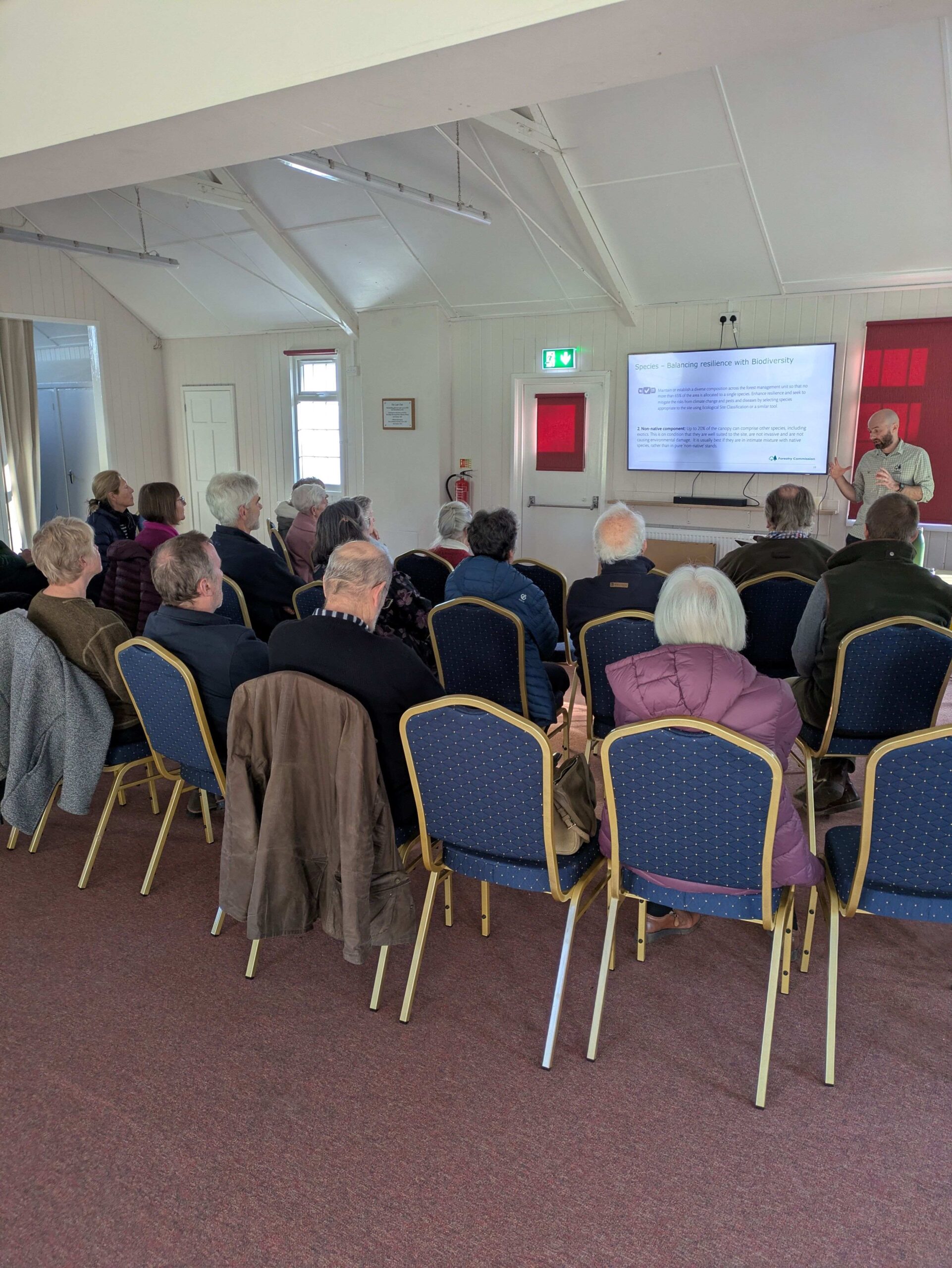
A group of over 20 attended our presentation given by Jamie Cunningham, Field Manager for the South East of England.
Jamie opened his talk by explaining the work of the Forestry Commission at the highest level; to Protect, Improve and Expand the forestry sector in the UK. This is delivered through various tools:
- Environmental impact assessment of woodlands
- by providing grant funding where applicable across a number of different scenarios in the development and maintenance of woodland
- By applying adherence to relevant regulations
Regulations – codified as the UK Forestry Standard – apply at three levels:
- Legal regulations – mandatory
- Good practice – advised best practice
- Guidelines – for informing decisions
The presentation then moved on to the challenges that need to be considered and managed in a woodland context. These included:
- The dangers of unmanaged woodlands and the cost of bringing these areas back into a properly managed state – for which grants may be available
- Infrastructure – given the expansion in the size of forestry equipment, it can be a challenge to find suitable and safe access routes into the woodland
- Animals, including deer and squirrels, who cause significant damage if not controlled
- Breaking up of larger woodlands into smaller lots separately owned; this practice can make it more difficult to manage pests if not all owners agree an appropriate approach to resolving the issue.
- Pests – There have been over 20 new pests or diseases identified as present in the UK since the Millenium, including Ips Typographus, the 8-toothed saw beetle which can rapidly devastate spruce trees. This pest has arrived in the UK in the south east, and is closely monitored; infected sites are immediately felled and traps set. The worry for the UK is a potential migration north into Scotland, where the spruce stands are widespread.
Jamie lastly discussed the observed trends in planting non-native trees as woodland species; this list does not represent a recommendation by the forestry Commission as every planting planned should take into account the soil conditions and physical landscape.
The trees mentioned included both native and non-native species
- Italian Alder
- Shining Gum
- Macedonian Pine / Monterey Pine
- Lawson Cypress
- Wild Service Tree
- Wild Cherry
- Hornbeam
- Cricket bat Willow
The presentation concluded by taking questions from the audience.