
A group of 20 gathered in the splendid Loose Pavilion Hall to hear Peter Blandon talk about “Cedar, Cypress and cherry; trees and forestry in Japan” based on his broad experience of lecturing and living in the country
His first theme explored the forest cover in Japan; who would have imagined that a staggering 60-70% of such a densely-populated country is woodland. The explanation is simple: trees can grow over mountain sides – Japan is a very mountainous country – where people cannot easily thrive. Of the overall woodland cover, over half is natural woodland, and around 40% is forestry plantation.
There are two main tree species accounting for more than 50% of natural forests and more than three-quarters of plantation forests; these are:
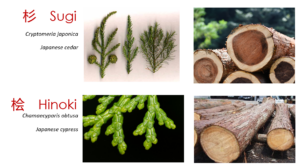
Japanese Cedar (“Sugi”) and Japanese Cypress (“Hinoki”); of these Sugi grows on the lower slopes, matures more rapidly and is, in general, of lower value and Hinoki which grows more slowly on the upper slopes is of more value.
Japanese reliance on home-grown timber began under the isolation of Japan under the Shogunate, between 1600 and the mid nineteenth century. This drove the use of high-quality timber for building purposes. Carpentry practices were also developed that allowed, amongst other things, long timber lengths to be joined to create large spans without nails or glue – a skill still retained to this day.
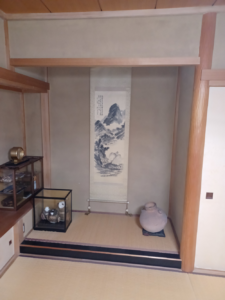
The high-quality timber required which, when used denoted wealth and high status, also drove the adoption of particular forestry practices to grow long, straight tree trunks with no knots in the timber when felled for use. The timber of the highest quality sells for much higher prices than timber with even one knot showing, and in modern times these timbers may be used for the one or two “Japanese style rooms” in an otherwise more conventional house.
Some interesting facts/correction of common fallacies:
- Wooden houses do not resist the power of large earthquakes better than those made of other materials.
- In Japanese conditions wooden houses do need to be replaced regularly – every 30 years of so.
- The detail of Japanese-style rooms”, e.g. paper “shoji” style partitions are replaced frequently and are not durable.
Cherry blossom, much lauded and admired in Japan and around the world, is mainly from one species of flowering cherry. As a result, large areas of cherry flower simultaneously and forecasts are given annually of the expected flowering dates of the trees starting earliest in the south and gradually later the further north in Japan you are.
The presentation demonstrated Peter’s deep affection for the country and his broad knowledge of the subject.