
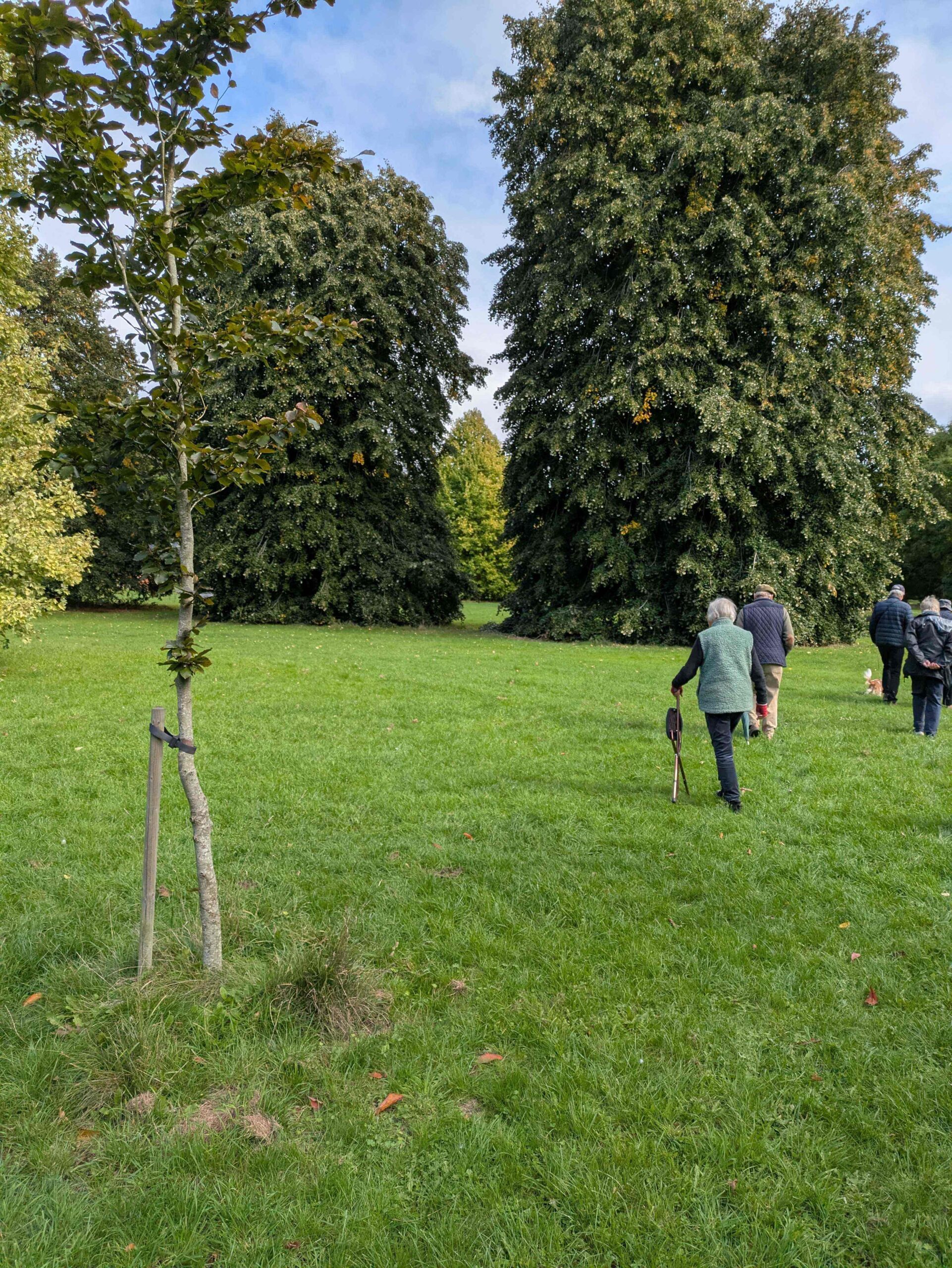
This visit to Mote Park was a revelation; for some of us it was a first-time visit, whilst others had passed through at various times in past years …but every single member of the group came away with a completely altered view of what was there…
We were guided around by Alan Frith, the Park Manager for 15 years, who generously gave nearly 3 hours of his time to us, sharing information and stories as well as pointing out trees, pathogens and responding to all our many questions.
Supported by 1 Ranger and 4 Ground staff, Alan looks after the whole park, comprising around 54,000 trees across around 450 species, including many ancient, veteran and champion amongst them. The trees are surveyed every 3 years as part of the health / risk assessment of the estate and to support the management planning.
We met at the Mote Park Learning Centre, and Alan took us immediately to an avenue bordering the entrance drive. This was a very ancient Beech avenue, dating from around 1800 when the New House around which the estate (now Mote Park) was built. This was one avenue of trees into the estate; there are / were also oak, lime, and walnut avenues of which vestiges remain and where new trees have been planted to continue to represent the original theme.
At the start, but also further on during the visit, Alan talked about the impact of pathogens attacking the trees, and the response of the management team. The team priority is safety for all visitors to the public park, but they also, crucially, operate on the basis that a tree has value throughout its life and on into death. The management is seeking a balance of 60% living wood in the park and 40% dead wood; dead wood can be standing – a monolith – or fallen to support invertebrates of all kinds, and the smaller brush is chipped and used as mulch. No wood leaves the site!
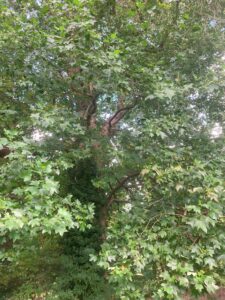
As we walked, we admired a Tulip Tree (Liriodendron tulipifera) – an ancient and veteran tree probably 300 years old and planted as a display of wealth by the then owner, and now also the national champion by girth.
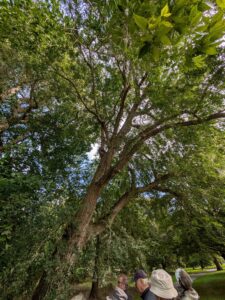
Nearby was a Siberian Elm (Ulmus pumila) which is the Uk and Ireland champion by height and girth…and is free from Dutch Elm disease.
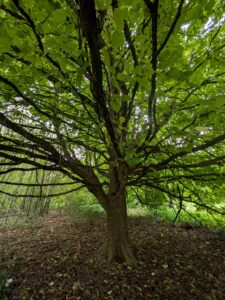
We wandered through the dedicated “Fagus area”, another collection of 25 oak species and found a wonderful collection of hazel, including some magnificent Turkish Hazel (Corylus colurna).
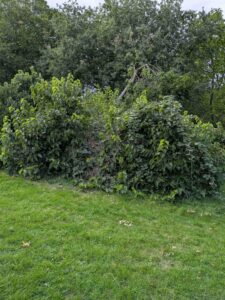
The most recent estate house complex, now flats, was impressive but did not distract us as we wandered by, stopping to admire a layered black mulberry (Morus nigra) that is so elderly it has simply fallen over and continues to grow.
There is more, much more for us to explore in Mote park, but this must wait for another time…
Photos by George Kirby and Tony Fincham (Tulip Tree)