
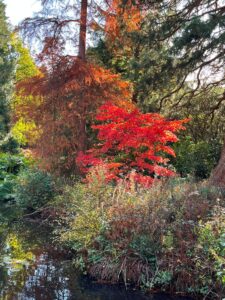
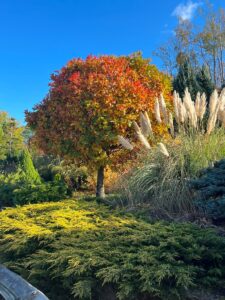
This was our last day trip of the 2026 season; our timing was perfect…bright and sunny weather, many trees showing Autumn colour. This was our second visit to Bedgebury in 2 years; last time we focused on the Pinetum…this visit we were hoping to explore other areas of the “estate”.
Liz, whose main role in the Bedgebury team is as Database Manager, and therefore responsible for maintaining the details of the 12000 specimen trees of the collection, was our guide for the visit.
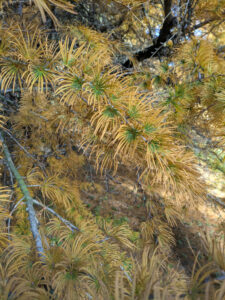
Our walk started through the pinetum and down a slope to an area with some interesting conifers; Liz had paused here to point out the Golden Larch which is actually not a larch at all but belongs to the pine family. It also goes by the name “dragon eye” due to the look of the cluster of needles – a beautiful tree.
We wandered on and stopped by the entrance to a long avenue of Lawsons Cypress, a part of the formal approach to the original estate house, called “Lady Mildred’s Avenue”. Liz also pointed out that in this area a number of conifers were dying – from the bottom upwards – as infected by a fungal disease whose source was not known and where apparently healthy cuttings from affected trees were also succumbing – a sad situation that the Bedgebury team is trying to resolve.
Onwards to “The Plots”…whatever they may be! Liz explained the history; first established in the 1920’s when timber was much in demand after the Great War, certain sections of land at Bedgebury were designated for planting specific species to determine which would be the most suitable as a commercial timber crop. Each plot was 0.25 acre and densely planted with one species. Eventually the research was abandoned as Sitka Spruce was the selected tree species.
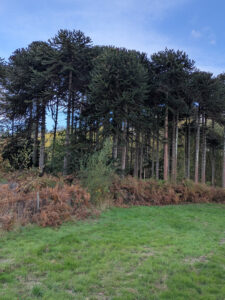
The great Storm of 1987 ravaged the plots, such that only 1/3 of the trees remained, …we saw a few Dawn Redwood in one plot and a stand of Monkey Puzzle trees in another; the latter quite impressive and lacking their lower branches completely as the trees struggled upwards to reach the light.
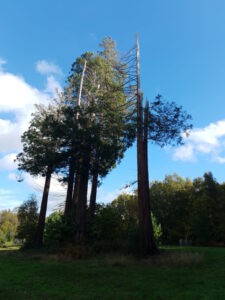
Areas of the original plots were reclaimed to form the “Bedgebury Conifer Conservation Project” site, where multiple examples of endangered conifer species from all over the world are planted out after, usually, propagation from seed at Bedgebury.
This area is now split into geographical zones, each supporting trees from that specific zone – we wandered through three zones: Europe, Australia, South America and Asia. I think some of us were surprised that European conifer species might be endangered – but the Spanish fir is such an example; in the South American zone there were many species of Monkey Puzzle tree to admire; we were not surprised at spotting the Wollemi Pine in the Australian zone!
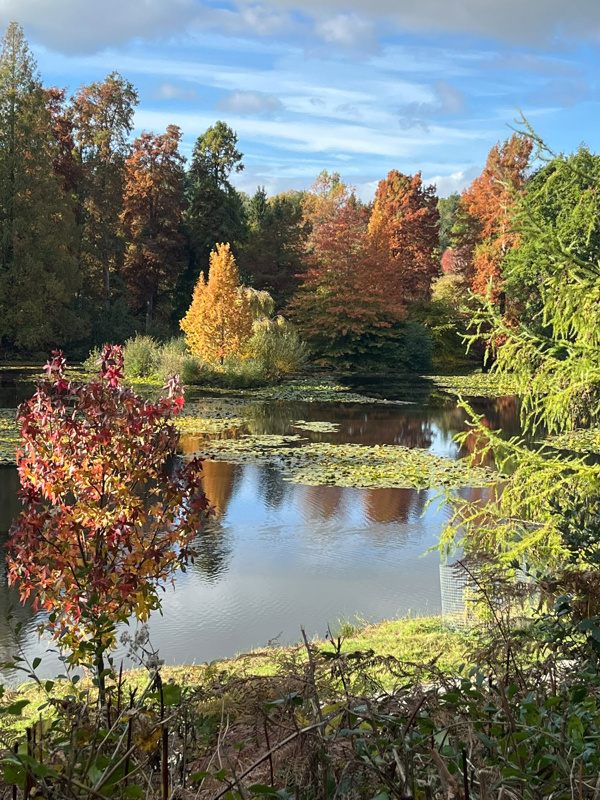
After leaving the Plots, we passed by a favourite view of Autumn colour reflected also in one of the Bedgebury lakes – a beautiful sight – on our way back to the visitor centre for refreshment!
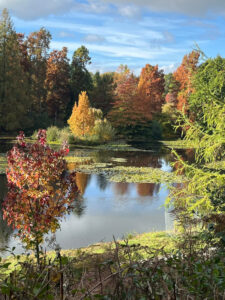
Photo credit – Mary MacEwan and Rose Pullen